Coordination Is a Skill: Why Repetition Changes a Movement
Coordination improves when repetition gives you time to notice a movement’s sequence, adjust one detail and choose a practice style that suits you.
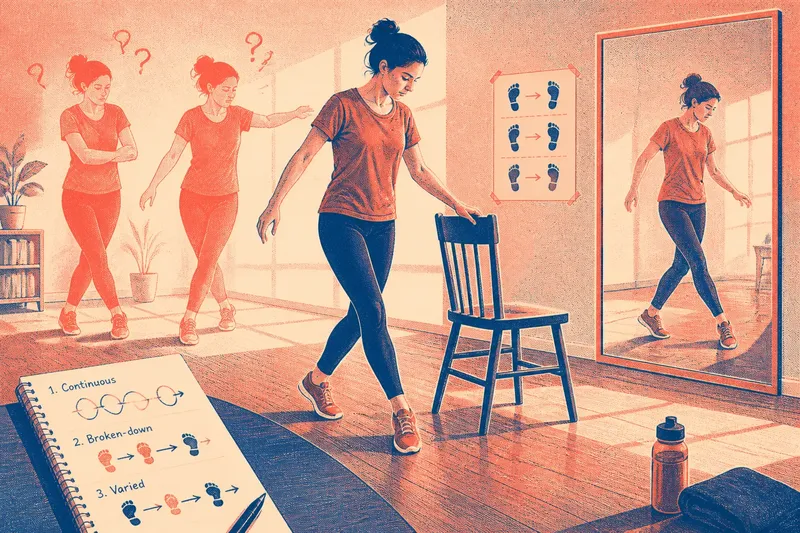
You try a new dance step in the kitchen: your feet arrive late, your arms join in at the wrong moment, and the whole sequence feels crowded. Coordination is a skill, and repeating the movement gives you another chance to notice its order rather than merely count attempts. The useful question is not how many times you can do it, but what each repetition lets you see.
What repetition reveals
A movement is a sequence of decisions made quickly: where to place a foot, when to shift weight, how far to reach and what to do next. At first, attention may be occupied by the whole task. Repetition can make familiar parts easier to recognise, leaving more room to notice a particular transition.
That transition is often where coordination falters. In a step-and-reach, for instance, the reach might begin before the weight has settled over the standing foot. Repeating the sequence slowly can make that timing easier to notice. It does not mean every attempt will feel smoother; it gives you another opportunity to observe what happened.
There is a difference between repetition and deliberate practice. Repetition means doing the action again. Deliberate practice adds a clear point of attention: the order of the steps, the direction of a turn, or the moment a hand changes position. Without that point, it is easy to reproduce the same muddle while becoming more tired.
Three practice styles
Most people can choose among three useful approaches: continuous repetition, broken-down practice and varied practice. None is best for every movement or learner. The right choice depends on whether you need to recognise the overall flow, understand one awkward link or use the skill in changing situations.
Continuous repetitions
Here, you repeat the full movement at a comfortable pace. This suits a simple sequence whose parts are already familiar, such as stepping forward and back to a steady beat. Keeping the whole pattern together helps you notice its rhythm and whether one side feels different from the other.
Continuous practice can be less helpful when a confusing transition keeps interrupting the flow. If you are guessing what comes next, simply restarting may give you little new information. Choose this approach when you can perform the general sequence without needing to stop and reconstruct it each time.
Broken-down practice
Instead of repeating the full sequence, practise a short section on its own. This suits a movement with one unclear link, such as turning after a step or moving the hands while the feet change direction. You can give that link your attention without asking yourself to remember every other part at once.
The drawback is that a part may feel easy on its own but awkward when reattached to the whole. Once the link seems more familiar, return to the complete sequence and notice whether the transition still makes sense. Keep the section small enough to identify what you are practising, not so small that it loses its purpose.
Varied practice
With varied practice, you change a manageable feature while keeping the movement recognisable. You might practise the same side-step facing a different direction, or respond to a slower and then a quicker cue. This can suit someone who knows the basic action and wants to become more adaptable rather than memorise a single presentation.
Too much variation too soon can make it hard to tell which part needs attention. Begin with a stable version; change one feature only when you can still recognise the sequence. If each attempt feels like a new task, return to a simpler arrangement.
Choosing a practice style
Start by asking what you can currently notice. If you know the sequence and want to feel its rhythm, repeat the whole movement. If one junction keeps catching you out, isolate that part. If the basic pattern is familiar but you want to respond to small changes, add a modest variation.
Say you are learning a grapevine step in a dance class and keep crossing your feet in the wrong order. Imagine practising the foot sequence slowly beside a chair for balance, without adding the arm pattern. Once you can name which foot crosses and when, rejoin the steps and arms at a relaxed pace; the observable sign of progress is being able to carry the crossing into the full sequence without losing your place.
That example is not a prescription for every learner. If a movement causes pain, dizziness or unusual discomfort, stop and seek advice from an appropriately qualified professional. Otherwise, a useful practice choice is one that makes the movement easier to observe, not one that looks impressive from the outside.
Questions about coordination?
How many repetitions should I do?
There is no universal count that suits every movement or person. Repeat while you can still pay attention to your chosen detail, then pause or change the task when fatigue makes observation difficult.
Should I practise slowly?
A slower pace can give you more time to notice order and timing, especially when a sequence is new. Keep the movement comfortable, then try a more natural pace when you can follow the parts without rushing to remember them.
What if one side feels less coordinated?
Notice whether the sequence, balance or direction differs between sides, and practise the less familiar version at a manageable pace. Avoid treating a difference as a failure; if it comes with pain or a sudden change in ability, consult a qualified health professional.
Is watching a demonstration enough?
A demonstration can clarify the order of a movement, but watching does not tell you what your own body is doing. Try a comfortable version yourself and attend to one feature, such as where your weight shifts or when your hand changes direction.
Feedback that helps
Useful feedback is specific and easy to act on. A mirror may help you see whether an arm reaches across your body, while a quiet verbal cue such as “step, shift, reach” can remind you of the sequence. Choose a single source of feedback at a time; watching your reflection, listening to instructions and correcting several body parts all at once can crowd your attention.
You can also pause briefly after an attempt and ask, “Where did I lose the order?” That question is more useful than deciding that the whole movement was bad. If you cannot identify the moment, simplify the sequence or ask a coach or instructor to describe one observable feature to watch.
Not every detail deserves attention. Matching a dance step perfectly to a mirror image or chasing a flawless-looking shape may take effort away from understanding the sequence. Prioritise the feature that changes how the movement flows, and let minor cosmetic differences go.
Making practice usable
Keep practice brief enough for attention to remain available. A few focused attempts can tell you more than a long stretch of unfocused repetition, particularly when the task is unfamiliar. Between attempts, relax your shoulders, reset your stance and decide what you will watch next.
Move from one practice style to another when your question changes. Begin with a broken-down section if the order is confusing; reconnect the full movement when the link becomes clearer; add a small variation when the complete sequence feels familiar. You are not obliged to progress on a schedule: returning to an easier version is a sensible way to restore a clear point of attention.
Coordination grows through noticing as well as doing. When repetition gives you a clearer picture of what comes before, during and after a tricky moment, it has served its purpose. That is the practical value of coordination practice: the next attempt begins with a better question than “Can I do it again?”