Before the Fitness Class: How Group Exercise Took Shape
See how group exercise developed from physical education, dance and organised training, and understand how those traditions shaped the classes on your timetable.
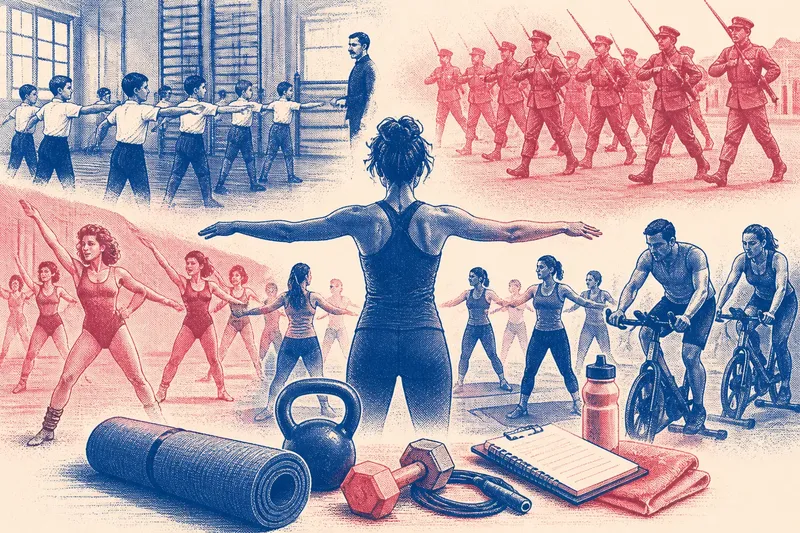
A teacher marks time at the front of a hall while a line of pupils copies a set sequence. That simple scene points to one strand in the history of group exercise: organised physical education, where a leader taught movements to a group. Group exercise did not begin with one inventor or one format; its familiar class structure drew on several traditions.
To understand how group exercise took shape, it helps to separate the strands that later appeared together: school gymnastics and physical education, community dance, military drill, and instructor-led fitness sessions. Each contributed a different tool, from orderly sequences to music and shared pacing.
School movement
In the nineteenth century, physical education became more organised in schools in parts of Europe and North America. German gymnastics associated with Friedrich Ludwig Jahn, often called Turnen, used structured exercises and apparatus. Swedish gymnastics associated with Per Henrik Ling emphasised systematic movements and instruction. These were distinct approaches, not a single system, and their influence varied by place and institution.
School settings made a leader-led format practical: a teacher could demonstrate, call out movements and keep a class working through the same sequence. That arrangement is one ancestor of the modern fitness class, though school gymnastics was not simply an early version of today’s studio workout.
Dance and drill
Dance has long brought people together through shared rhythms and repeated patterns. In the twentieth century, dance-based exercise made that combination part of organised fitness; jazzercise, founded by Judi Sheppard Missett in 1969, blended dance and exercise instruction. Its format shows how music and a teacher-led routine could turn familiar movement into a fitness session.
Military drill contributed another idea: groups can move in response to common commands and timing. Drill served military purposes rather than recreational fitness, so it should not be treated as a direct origin for every class. Still, the practice of following cues together resembles one feature of many group sessions.
Fitness classes emerge
During the twentieth century, fitness organisations and commercial studios developed classes for people seeking exercise outside school or military settings. Aerobics became widely associated with choreographed movement and music; in the 1980s, televised exercise programmes helped bring instructor-led routines into homes as well as gyms. These formats differed in setting and style, but shared a repeatable session led by a teacher or presenter.
Other classes placed less emphasis on choreography. Cycling sessions, circuit training and strength classes used equipment or timed stations, while keeping the group within a common plan. The class could therefore be collective without asking everyone to perform identical movements.
Elements of group exercise
Modern classes combine these influences in different proportions. A dance session may use music to shape movement, a strength class may depend on demonstrations and technique cues, and a circuit may let participants work independently while sharing the same timetable.
- Shared instruction: If you want clear guidance, check whether the description mentions demonstrations or coaching; if it does, expect the instructor to explain movements, while if it does not, ask the organiser what support is available.
- Music and rhythm: If the class is described as dance-based or music-led, expect the beat to shape timing; if you prefer spoken cues, choose a class with lower-volume music or ask about sound levels.
- Unison: If choreography or synchronised movement is named, expect some shared timing; if that feels uncomfortable, look for a class where participants can choose their own pace.
- Equipment: If the listing names mats, weights or bikes, check whether they are supplied; if availability is unclear, contact the venue before attending.
- Beginner options: If modifications or introductory levels are mentioned, expect alternatives to be offered; if not, ask the instructor whether you can adapt the movements.
- Room layout: If a class uses rows or fixed stations, expect assigned spaces or equipment; if you need a clear view of the teacher, arrive early enough to ask where to stand.
Say you are new to classes, prefer spoken guidance and have only a mat listed among your available equipment. You compare two descriptions: one advertises dance choreography and loud music, while the other promises coached floor exercises and says equipment is provided. You choose the second, ask whether beginner modifications are offered, and learn that the venue supplies what is needed; the resulting trade-off is a quieter, more instruction-led session rather than a music-driven one.
Questions about group exercise?
What is the difference between a class and a group workout?
A class usually follows a plan led by an instructor, while a group workout can simply mean people exercising at the same time. In practice, venues use the terms differently, so check whether a teacher leads the session and what participants are expected to do.
Did aerobics invent group exercise?
No. Aerobics helped popularise a recognisable music-led fitness class, but school physical education, dance and other forms of organised movement came earlier. Its place in the story is as one influential format, not the sole origin.
Do all group exercise classes follow the same routine?
No. Some use choreography or a shared sequence, while strength circuits and cycling sessions may allow individual effort within a common structure. The description should indicate whether synchronised movement is central.
What should I check before attending?
Look for the class level, equipment requirements, music style and whether the instructor offers demonstrations or modifications. If any detail is missing, contact the organiser rather than guessing about what to bring or how the session works.
What needs less effort
There is little value in memorising a routine before your first class or buying specialist clothing just to match the group. Comfortable clothes that allow free movement are often enough, but follow any specific equipment or clothing guidance from the venue.
The history of group exercise is not a straight line from one tradition to another: school instruction, dance, drill and organised fitness each contributed different elements. When searching for group exercise, use those elements as clues—look for the teaching style, music and degree of synchrony that fit you, then ask the organiser about anything the timetable leaves unclear.