The More Is Better Assumption: When Extra Training Adds Complexity
Extra training can blur a good plan. Learn to judge each added session or exercise by its purpose, so your routine stays easier to understand and follow.
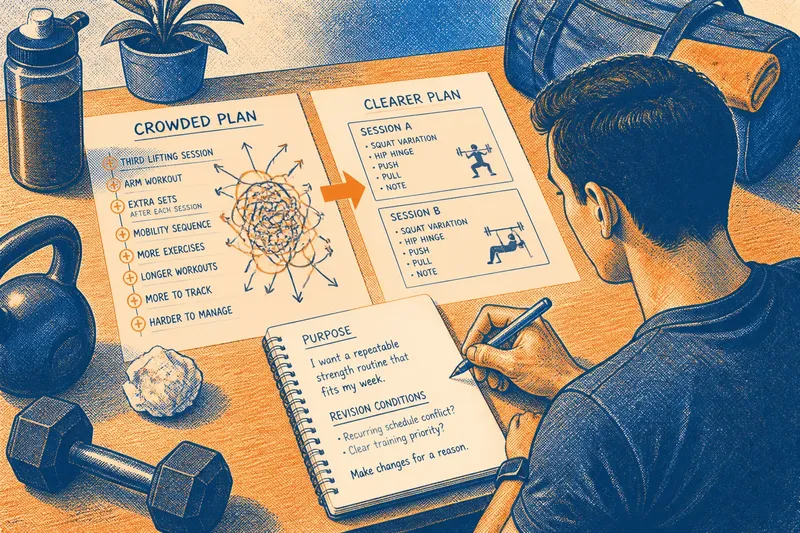
On Monday evening, Sam opens a training notebook and adds another workout to the week. The current plan already feels busy, but a new exercise from a friend’s routine looks useful. Sam’s question is not whether more training can be valuable; it is whether this particular addition makes the plan clearer or harder to manage.
That is the more-is-better assumption in miniature: treating another session, exercise or training method as an automatic improvement. Imagine Sam is a fictional person with a simple aim: build a regular strength-training habit while keeping evenings manageable. The example below follows Sam from a crowded plan to a more deliberate one. It is invented, not a report of a real person’s results.
The crowded week
Sam’s starting plan has two full-body strength sessions. Each includes a squat variation, a hip-hinge movement, a push and a pull, followed by a short note about how the session felt. Sam has been able to fit these workouts around work and home commitments, and can explain what each one is for: practising a manageable set of basic strength movements.
Then the additions arrive. Sam considers a third lifting session, a separate arm workout, extra sets at the end of each session and a new mobility sequence. None is inherently a poor choice. Together, though, they turn a plan with a clear shape into a list of options with no obvious priority.
That matters because every addition asks for a decision. Should Sam do the extra session after a tiring day? If it is missed, does the rest of the week need rearranging? Should the new exercise replace an existing one or sit alongside it? A plan can become harder to follow even when every item seems sensible in isolation.
Name the purpose
Before changing anything, Sam writes one sentence: “I want a repeatable strength routine that fits my week.” It is not a performance target or a promise about what will happen. It is a practical filter for the current decision.
Sam then asks what each proposed addition is meant to do. A third session might provide another opportunity to practise strength movements, but it also takes an evening and adds recovery demands. An arm exercise might offer more focused work, but could be less relevant to the broad aim than a movement already in the plan. The mobility sequence may address a personal preference or a specific limitation, but Sam has not yet identified one.
The useful question is not simply, “Is this exercise good?” It is, “What job would it do here, and what would it replace or require?” That second part brings the real cost into view. Training time is only one cost; attention, scheduling and the effort of keeping track of a more elaborate routine count too.
Check the plan’s shape
Sam lays the proposed week beside the existing one and looks for overlap. The extra arm workout repeats some work already present in the pushing and pulling movements. That does not make it pointless, but Sam cannot name a particular reason to give it a separate place. It is therefore the first addition to leave out.
The extra sets are less clear. Sam has no written reason for increasing them, and adding them everywhere would make it difficult to tell which part of the plan mattered. Instead, Sam keeps the existing exercise selection and records whether the sessions feel manageable and whether the routine fits the week. This creates a more useful basis for a later decision than changing several things at once.
The third session has a more specific purpose: it could provide another chance to train when a work commitment regularly disrupts one of the usual evenings. But Sam’s schedule is not actually making the current sessions difficult to attend. For now, a third session solves a problem that has not appeared. Sam leaves it out rather than reserving time for a hypothetical need.
Finally, Sam considers the mobility sequence. Rather than treating it as a required extra, Sam notes that a brief, comfortable warm-up before training is already part of the routine. A separate sequence can remain an option if Sam identifies a clear reason to use it. The distinction is modest but useful: something need not be added to the weekly plan merely because it might be beneficial in some circumstances.
Decide what earns space
After this review, Sam keeps the two existing sessions and makes no immediate increase to the exercise list. The result is not a claim that the original plan is perfect. It is a plan Sam can describe, schedule and review without having to interpret a pile of new requirements.
Sam also sets a simple condition for revisiting the choice: if a recurring schedule conflict makes one session hard to attend, consider whether a different weekly arrangement would help. If the current sessions become consistently manageable and Sam has a more specific training aim, consider a targeted change. The condition is tied to an observable situation, not to the vague feeling that the routine ought to look more ambitious.
A change can also be small. Sam might replace one movement with another that better suits available equipment, or add a focused exercise because a particular training priority has become clear. The point is not to keep the plan frozen. It is to make each revision legible, so Sam can tell what changed and why.
Questions worth asking?
How do I know whether an extra workout belongs?
Give it a specific job, such as solving a recurring scheduling problem or serving a defined training priority. Then consider what the session asks of your time and recovery, and whether the same job is already being done elsewhere in the plan.
Should I add exercises when progress feels slow?
First identify what “slow” means in your situation and whether you have a consistent routine to assess. Adding several movements at once can make it harder to tell what is helping; a qualified fitness professional can advise if you need individual programming.
Can a shorter plan still be a serious plan?
Yes. Seriousness is not measured by how many items appear on a weekly schedule. A plan can be deliberate when its sessions have a clear purpose and fit the person’s circumstances.
What if I enjoy extra training?
Enjoyment is a valid reason to make room for an activity, provided it fits your needs and does not turn the rest of the routine into an unmanageable obligation. You can treat it as an optional choice rather than a new rule that must be followed.
What is not worth tracking
Sam does not need a colour-coded calendar for every exercise, a long explanation for every skipped session or a complicated score for how productive a workout felt. Those details would add admin without answering the main question. A brief note about attendance, how manageable the sessions felt and any recurring obstacle is enough to support this particular decision.
Nor is it useful to copy another person’s full routine just because it looks complete. Their available time, preferences and training aims may differ. Sam can borrow a single idea and still ask whether it has a place in Sam’s own plan.
A clearer next choice
By the end of the walk-through, Sam has not added a new session or a stack of exercises. Instead, Sam has a reasoned way to decide what might earn a place later: identify the need, name the addition’s purpose, check for overlap and consider the practical cost. The outcome is a smaller plan, but its logic is easier to follow.
When you wonder whether more training belongs, try writing down the proposed addition and finishing this sentence: “I am adding this because…” If the reason is specific and the plan still fits your life, the change may make sense. If the sentence trails off into “because more must be better”, pause; with training, a clear purpose is more useful than another item on the list.